Ask The County Agent: What’s wrong with my Camellia leaves?

By STEPHANIE BUTCHER, UGA Coweta County Extension Coordinator
QUESTION: What is wrong with my camellia leaves? Some of them are light green and thicker than normal.
AGENT: Your plant is infected with camellia leaf gall. It is caused by the fungus Exobasidium camelliae and is more often found on sasanqua than japonica camellias. A similar leaf gall can be seen on azaleas in the spring.
These galls may not look good, but they are not a cause for concern regarding the overall health of the camellia. Severity of the disease varies according to the weather conditions when leaf expansion begins in the spring. Cool, moist weather favors disease development. This disease is rarely seen when the weather is dry but if a sprinkler system is used, then it can provide enough moisture for the disease to develop.
The lifecycle of camellia (and azalea) leaf gall is poorly understood. Since it is more of an aesthetic problem, there has been little research into figuring it out. It is thought that the fungus survives during the winter in leaf buds and infects the expanding leaf tissue in the spring. Instead of developing normally, the new leaves become thickened and succulent and may be larger than normal. The diseased leaves are a light green to pinkish-green color.
Eventually, the epidermis on the underside of the camellia leaf peels away and exposes a white surface. On azalea galls, the whole galled leaf or flower turns white. Spores are released from the white surface and are dispersed by air currents and splashing water. The galled leaves will dry and turn brown to black in late spring.
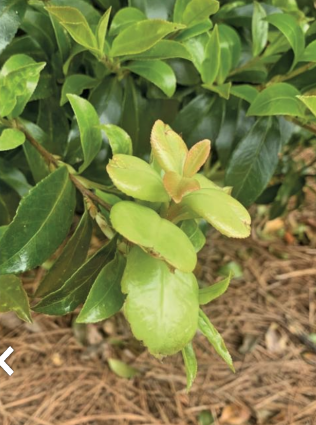 To control camellia leaf gall, you can remove and discard the galled leaves and/or flowers as soon as symptoms are seen and before the surfaces turn white and spores are released. Fungicide applications are not recommended once the disease is present, but they can be used in early spring (as the buds begin to swell) to help prevent the development of the disease.
For more information about camellia and azalea leaf gall, contact the Coweta County Extension office at 770-254-2620 or email [email protected].
The University of Georgia College of Agricultural & Environmental Sciences is an equal opportunity, affirmative action organization.
Photo Credit: UGA Cooperative Extension, Ben Hill County


