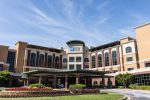
City of Hope: The State of Lung Cancer in Georgia

Pictured above are two thoracic surgeons – Dr. Jason Budde and Dr. Shady Eldaif – who offer their perspectives for World Lung Cancer Awareness Day that was August 1.
From City of Hope Press Release
Lung cancer is the second most common non-skin cancer diagnosed in both men and women — and it is the deadliest. The American Cancer Society’s (ACS) 2024 report estimates more than 125,000 people will die from lung cancer in 2024, making the disease by far the leading cause of cancer death in the United States.
In Georgia, ACS statistics show that lung cancer rates are significantly higher than the national average: an estimated 7,350 Georgians will be diagnosed with the disease this year. For City of Hope® Cancer Center Atlanta oncology experts Shady Eldaif, M.D., director of Thoracic Oncology; and Jason Budde, M.D., thoracic surgeon, the main reasons for Georgia’s elevated lung cancer cases are clear: smoking habits and, to a lesser extent, radon exposure.
“Because there’s not a significant genetic predisposition, like with breast cancer or certain types of colon cancer, risk primarily hinges on smoking habits and history,” Dr. Eldaif says. “Radon content in the South tends to be higher, and that also contributes to lung cancer.”
Smoking is the leading cause of lung cancer, but radon exposure is the biggest risk factor for never-smokers, according to the U.S. Environmental Protection Agency. People are exposed to radon — a colorless, odorless radioactive gas that forms when metals in rocks and soil break down — when it seeps through cracks and gaps in building foundations, basements and subfloors. Data also shows a rise in lung cancer in individuals who have never smoked or been exposed to radon, though the cause is still under investigation. Nonetheless, smoking cessation and radon monitoring may help Georgians reduce their risk of lung cancer.
Why Lung Cancer Rates May Be Higher in Georgia
Across multiple statistics related to lung cancer, Georgia consistently struggles. Georgia has higher-than-average smoking rates, at 16%, and according to the American Lung Association’s annual State of Lung Cancer report, Georgia scores below the national average in:
• Screening rate (only 3.8% at-risk Georgians were screened)
• Early diagnosis
• Surgical treatment
• Survival rate (overall, and significantly lower based on racial and ethnic disparities)
“Early-stage lung cancer patients almost never experience symptoms. When high-risk patients wait until symptoms occur to undergo testing, about two-thirds of those patients are then diagnosed at an advanced stage,” Dr. Budde explains.
Unfortunately, at advanced stages, three-fourths of patients will not be alive in five years. Identifying lung cancer early through screening is the most effective way to increase survival in lung cancer.
The Key to Improving the State of Lung Cancer: Screening
Cigarette smoking still accounts for 30% of all cancer deaths across the United States, and as much as 40% in the South. The good news is many current and previous smokers qualify for screening. According to data from the U.S. Preventive Task Force, for patients who receive appropriate screening, lung cancer survival rates increase by 30% to 50%.
In 2023, the guidelines for lung cancer screening received an important update, making it easier for more patients to qualify for screening. Lung cancer screening usually involves a low dose computed tomography (LDCT) scan. At-risk patients are urged to get screened once a year, and almost all insurance plans and Medicare cover the procedure for those who meet current guidelines.
Annual screening with LDCT is recommended for individuals at average risk who:
• Are between 50 to 80 years in age
• Are a current or former smoker
• Have a 20-plus pack-year* smoking history
“Thankfully, many hospitals and physician offices offer screening services,” says Dr. Eldaif. “It is crucial that we enroll our high-risk patients in a routine screening program to monitor their progress. Patients who believe they qualify should speak with their doctor about getting screened. Early detection is crucial.”
*Twenty pack-years means that the patient either smoked one pack of cigarettes a day for 20 years, or a half pack a day for 40 years, and so on.
Diagnosing and Treating Lung Cancer
According to Dr. Budde, “Innovation means patients have the best chance of cure, the least chance of recurrence and better quality of life after cancer.” Due to remarkable advancements in interventional pulmonology and thoracic surgery, diagnosing lung cancer may require minimal to no invasive procedures. Physicians now use tools such as:
• Lung Nodule Diagnosis: If a CT scan reveals a lung nodule, whether identified during screening, in response to symptoms or found incidentally, a positron emission tomography (PET) scan, minimally invasive biopsy or other testing can aid physicians in diagnosis.
• Artificial Intelligence (AI): AI use is an ensemble approach where human experts and advanced technology work together. Radiologists individually read and interpret thousands of scans, and AI is used in conjunction to analyze scan reports and may help increase nodule detection and precise measurement.
• Future Options: Several new screening methods are in development, including blood tests that look for tumor DNA. While these are not yet approved for routine use, they are available commercially and show a great deal of promise.
Approaches to treating lung cancer have also evolved thanks to advancements in precision medicine. Genomic-informed treatment such as chemotherapy, immunotherapy or other targeted therapy before surgery may be an option for shrinking or curing tumors. Studies also have shown that a segmentectomy, which removes a smaller section of lung tissue, is as effective as the standard procedure, a lobectomy, in taking out the cancer and preventing recurrence while maintaining a better quality of life. In those cases, patients may encounter fewer issues post-surgery and retain more of their breathing capacity.
Researchers continue to search for innovative ways to detect cancer earlier and monitor the effectiveness of current screening guidelines. In the meantime, urging friends, family, colleagues and patients who smoke to undergo a low-dose CT scan screening is the most powerful way to save lives from lung cancer.
City of Hope Atlanta’s comprehensive cancer services include our Lung Cancer Center, which features a Lung Screening Program and Rapid Lung Nodule Diagnosis Program providing radiology results in as little as 24-48 hours. We offer an integrative, person-first cancer treatment approach incorporating leading-edge cancer treatment and supportive care options under one roof. Learn more at www.cityofhope.org/locations/atlanta or call 855-939-HOPE.