Once Upon A Time: Newnan Cotton Mill and Mill Village

 By KATIE ANDERSON, Out and About Columnist
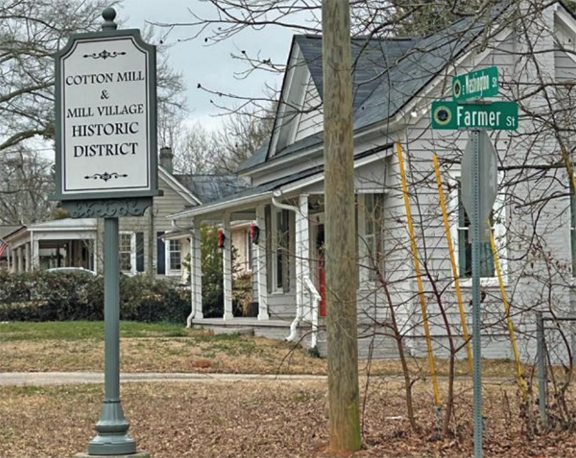
One of the best things about Newnan is how we preserve our history. With six historic districts, our city is bursting with stories from the past. Recently, I saw a sign for the Newnan Cotton Mill and Mill Village Historic District, and had to know more.
I’m talking about the area that is now Newnan Lofts Apartments, including the skate park/C.J. Smith Park, two churches, several streets of homes, and the beginning (or end) of the LINC. Turns out, once upon a time, it was a thriving cotton mill and mill village.
In April 2002, the area was designated as a historic district. The Newnan Cotton Mill was established in 1888 along the railroad to the west, and the district borders go up to Wilcoxen Street to the north, Farmer Street to the east, and East Washington Street to the south.
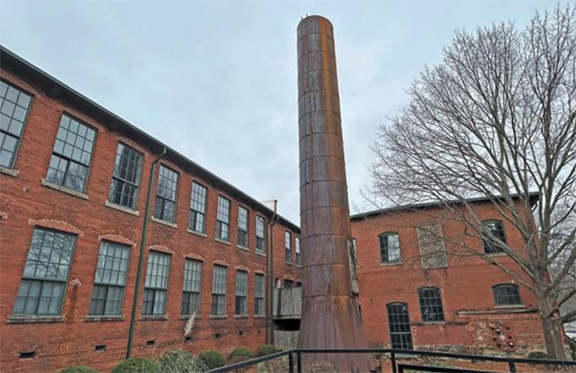
Today, as you catch the LINC on Field Street, you’ll see the FreeMasons building – in another time, the mill office building. As you continue to walk, you’ll notice the Lofts Apartments, aka the original mill buildings, and an iron water tower that once provided protection from fires in the mill. A spring-fed pond (now under a boardwalk along the LINC) supplied the water, which washed back into the pond after being sprayed on the building.
Keep strolling through C.J. Smith Park, once a baseball field built for the mill workers, and you’ll see some of the historic mill village. The first worker homes built by the mill, called “saddlebag houses”, were built on Factory Street (now Field Street) and Murray Street.
Later, three additional streets of duplexes and two-story saltbox houses were built for workers on Wilcoxen, Berry, and Glenn Streets. There are also five shotgun mill houses that were built on Cole Street and East Washington Street.
On Murray Street, the mill manager’s house still stands, as does the original Mills Chapel (now Sword of the Lord Church), and Lovejoy Methodist Church, all built as part of the mill village.
According to Winston Skinner, retired news editor of the Newnan Times-Herald and local historian extraordinaire, the mill village has held modern-day reunions with workers, workers’ family members, and even owners’ descendants attending. “The mill village had a great sense of community then that has continued into present times.”
Skinner also notes that working at the mill wasn’t an easy life. The work was difficult and at times, unsafe. Like most mills in the South at the time, the mill was segregated by race and gender.
Workers were getting injured at alarming rates. In Jeff Bishop’s Coweta County: A Brief History, Clifford Banks Glover recounted “the safety record was terrible…some of those machines would be running so fast that you’d cut yourself by just barely touching it with your finger. We had terrible accidents.”
Things got so bad that in 1934, a General Textile Strike was called, and Newnan Cotton Mill workers picketed with textile workers across the country. During the strike, the Georgia National Guard and local civil authorities arrested picketers. They sent them to detention camps at Fort McPherson until the end of the strike three weeks later. (– Emily Kimbell, Be Local)
Later, during WWII, the mill produced yarn for parachute and harness equipment, sometimes operating 24 hours a day, seven days a week.
By the 1950s, Newnan Cotton Mill employed over 1000 workers. Over the next few decades, it changed hands several times. Fast forward to 2024, the community remains with a multi-use path, a skate park, a playground, historic single-family homes, and upscale apartments. As Skinner said, and I paraphrase, these homes and buildings were built in another time and another life, but the structures outlive the people, to tell another story for another day.






Very interesting, really enjoyed the history of the mill villages.