The Tale Behind the Tales: Discovering Beatrix Potter
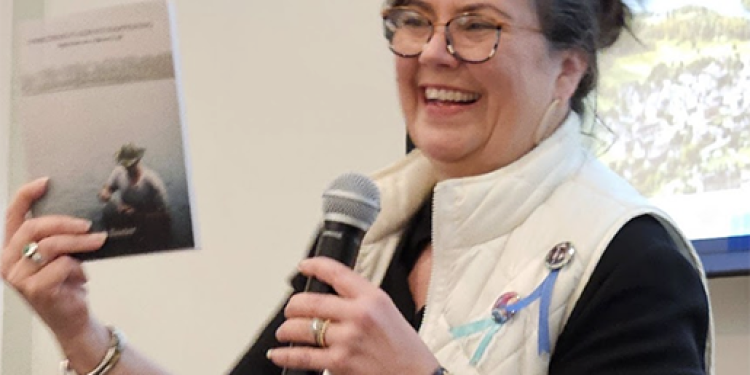
Pictured above: Melissa Dickson Jackson holds a copy of a book recently published by Mark Baxter, one of her students. She assisted with the book’s publication. Jackson gave a lecture on Beatrix Potter to members of the Mu Chapter of Delta Kappa Gamma, providing insight into a woman who was ahead of her time.
From Delta Kappa Gamma Mu Chapter Press Release
Before there was Peter Rabbit sneaking into Mr. McGregor’s garden, there was Beatrix Potter – an imaginative powerhouse with a sketchbook in one hand and a love for nature in the other.
Raised among the rolling hills of the English countryside, Beatrix turned her fascination with animals into whimsical tales full of charm, cheekiness, and irresistible watercolor critters.
Local educator and artist Melissa Jackson presented a program, “Beatrix Potter: Rebel Girl,” reflecting on the life of this amazing woman at the Mu Chapter meeting on Thursday, April 24.
Potter wasn’t just spinning bedtime stories. She was a trailblazer – one of the first women to self-publish a children’s book, a sharp business mind, and a dedicated conservationist who helped protect the wild beauty of England’s Lake District.
“She was born to a wealthy family during the Victorian Era, and she lived to the Atomic Age,” Jackson said of Potter. “Her parents expected her to be a proper little girl – polite and well-dressed, who would marry someone from their social class. She didn’t do what her parents expected, what her culture expected, what I expected.”
“She was fascinated with the natural world, and she had a menagerie of animals – rabbits, mice, hedgehogs, bats, and insects,” Jackson said. After her pet mammals died, Potter would skin and stuff them. “She was into accuracy, and she was into science. She needed the taxidermy models to study for her paintings,” Jackson said.
From her teens into her thirties, Potter kept journals written in cipher. Later reviewing them, “Potter could not decode her writings,” Jackson said. “Leslie Linder spent five years deciphering the code that Potter had invented when she was just 15 years old. The decoded diary provided a glimpse into Potter’s life and the Victorian society in which she lived.”
Darwin’s book On the Origin of Species was published around the time of Potter’s birth. “I believe it had a big impact on her,” Jackson said.
Another important influence on Potter was her father’s friend, John Everett Millais, an English artist who helped start a group of painters and illustrators known as the Pre-Raphaelite Brotherhood. Potter went on to study at the Royal Academy of Art.
“Potter was fascinated by fungi and spent many hours drawing and studying them in detail. She developed her own theory about the germination of fungal spores and even submitted a research paper to the Linnean Society in 1897. As a result of the Linnean Society’s strict gender rules, she was not allowed to present it herself,” Jackson said. “Potter’s illustrations of fungi were so accurate that mycologists continue to use them for identification purposes.”
“She was one of the first people to propose that lichens were a symbiotic relationship between fungi and algae, an idea that was ahead of her time and later confirmed by modern science,” Jackson said.
“We think of Beatrix Potter as the writer and illustrator of children’s books. It was not her intention to become a children’s author. She only wrote and illustrated children’s books for 10 to 12 years of her life. She stopped writing – and being called Beatrix Potter – when she married. She then preferred to be called Mrs. Heelis, and she became a sheep breeder,” Jackson said.
“Potter’s stories often began as picture letters to children she knew. The Tale of Peter Rabbit started as a letter to Noel Moore, the son of her former governess, when he was ill,” Jackson said. After six publishers rejected her manuscript, Potter used her own money to print the book herself.
Potter did not stop with books. “She was actually quite ahead of her time when it came to licensing and merchandise. As early as 1903, she designed and patented a Peter Rabbit doll herself, making Peter Rabbit the world’s oldest licensed literary character. She was very hands-on with her brand, creating and approving various items based on her beloved characters,” Jackson said.
Canon Hardwicke Rawnsley, a vicar who helped start the National Trust, cared deeply about saving the beauty of the Lqake District. His passion for conservation greatly influenced Potter. “With his encouragement, she used her wealth from her published works to purchase Lake District farms and put them into conservation,” Jackson said.
“In all, she purchased 15 farms and over 4,000 acres of land. She helped to preserve the unique landscape and way of life of the Lake District,” Jackson said. The National Trust became the beneficiary of Potter’s farms and land upon her death. “Her donations to the National Trust were a testament to her love of nature, her commitment to conservation, and her remarkable legacy as a pioneering woman and environmentalist,” Jackson said.
Potter – or Mrs. Heelis, as she later preferred being called – was independent when it came to her relationships. She fell in love with and became engaged to Norman Warne, her editor and publisher, against her wealthy parents’ wishes. Warne died a month after their engagement, but Potter continued wearing his ring. Eight years later, “she moved Warne’s ring to her right hand when she married William Heelis, whom her parents also opposed,” Jackson said. “She wore Warne’s ring on her right hand until she died.”
“Like Peter Rabbit escaping his costume, Beatrix Potter shed the conventions of her youth and the strictures imposed by her overbearing mother – first the left shoe, then the right, then the brass-buttoned jacket ensnared in the gooseberry net,” Jackson said. “William Heelis scattered her ashes in an undisclosed location without pomp or circumstance – no audience, no ceremony, no headstone. Her life came full circle as the lake-district landscape she so carefully observed and protected for most of her 77 years quietly absorbed the fine ash and remnant bone of Beatrix Potter Heelis.”
Jackson is another amazing woman. She wears a lot of creative hats – and she wears them well! A writer, educator, and visual artist, Melissa brings stories to life both on the page and in the classroom. With a background in American literature and writing, she teaches at the University of West Georgia while also penning thoughtful feature articles for publications like Thrive Magazine, Newnan Coweta Magazine, and Lifestyles.
Jackson is also a published poet, with two collections under her belt and work featured in a variety of journals. But her creativity doesn’t stop at words – she also holds an MFA in visual arts and is an accomplished artist in her own right.
DKG is a professional honor society for women educators with more than 55,000 members. Established in 17 member countries around the world, the Society defines its mission as promoting professional and personal growth of women educators and excellence in education. There are 58 DKG chapters in Georgia with more than 1,600 members. Mu Chapter serves Coweta County and the surrounding area. Society headquarters are in Austin, Texas, where Dr. Annie Webb Blanton founded the Society on May 11, 1929.